

Losing someone you love is devastating. When that loss is caused by another person’s negligence, whether in a car crash, medical error, or workplace accident, the grief is quickly followed by hard legal questions: Who can take action? What can be done?
In Georgia, the law does give grieving families a legal path to seek justice. But the process isn’t open to everyone, and time matters. Waiting too long, or misunderstanding who can file, can mean that the door closes before you ever get the chance.
But the rules about who can file are not always clear, and missing the legal window can mean losing that right entirely. A Georgia wrongful death lawyer can help clarify who’s eligible to file and guide families through the legal steps during one of the hardest moments of their lives.
But the rules about who can file are not always clear, and missing the legal window can mean losing that right entirely.
Here is a quick look at the leading causes of wrongful death in Georgia:
Car Accidents. 43%
Medical Malpractice. 17%
Workplace Incidents 12%
Criminal Acts (e.g. DUI) 9%
Other Causes. 19%
Understanding where you stand and who can legally file is the first step toward holding the at-fault party accountable. This guide explains it clearly, from eligible family members to Georgia’s legal process, timelines, and compensation rules.
Let us begin.
Table of Contents
Who Has the Legal Right to File a Wrongful Death Lawsuit in Georgia?
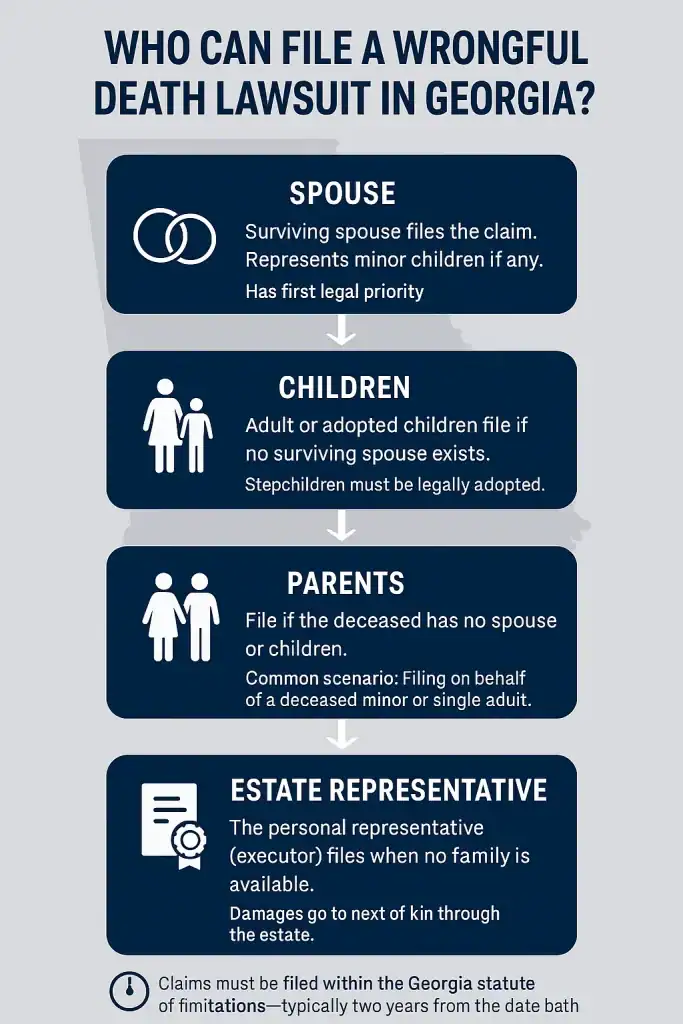
Georgia law clearly defines who can bring a wrongful death claim, but it follows a strict order of priority. The right to sue doesn’t extend to every grieving relative. It starts with the closest relative and moves outwards:
1. Spouse Comes First
If the person who died was married, their spouse has the first right to file. If there are minor children, the spouse files on their behalf too
Think of it this way: If a man dies on the job, his wife files the claim, not just for herself, but for their children as well.
2. If There’s No Spouse, the Children Can File
Adult children can bring the claim if there’s no surviving spouse. This includes adopted children as well. Stepchildren are not included unless they were legally adopted. under Georgia law.
3. No Spouse or Children? Parents Can File
If the person who died was unmarried and didn’t have children, a parent can file. This often comes up when a minor or young adult dies without dependents.
4. No Immediate Family? The Estate Representative Files
If no close relatives are able or available, the executor of the estate can file. Any compensation then goes to the next of kin through the estate.
How Georgia Defines “Wrongful Death”
Not every accidental death qualifies for a wrongful death lawsuit. Under Georgia law, a wrongful death happens when someone dies due to the “negligent, reckless, intentional, or criminal” acts of another person or entity. That can include individuals, companies, even government agencies.
Put simply, if the person who passed away could’ve sued for personal injury had they lived, then their loved ones might be able to bring a wrongful death claim now.
It often comes down to whether someone else’s actions, or failure to act, led to that death.
Some real-world examples we see in Georgia include:
- A drunk or distracted driver causes a fatal crash
- A doctor misses a critical diagnosis or makes a surgical mistake
- A worker dies on the job due to unsafe conditions
- Someone is killed during a violent crime, like a shooting or DUI
- A faulty product, like a malfunctioning airbag, leads to a fatal injury
In all these situations, the heart of the matter is the same:
Could this death have been prevented if someone had acted responsibly?
If the answer is yes, the law may give surviving family members the right to step in.
It’s worth noting that Georgia recognizes two separate legal claims tied to wrongful death:
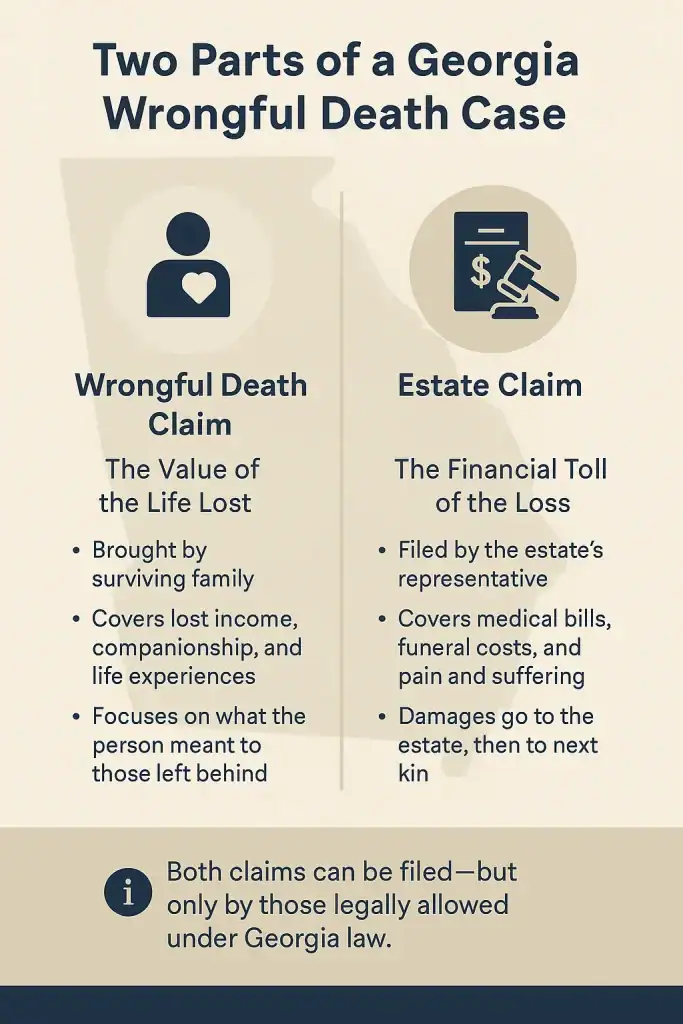
1. The wrongful death claim, which focuses on the full value of the deceased’s life.
2. The estate claim, which deals with costs like medical bills, funeral expenses, and pain and suffering before death.
Both may be pursued, but only by those legally entitled to file (as explained above).
What Can You Actually Recover in a Georgia Wrongful Death Case?
When someone you love is taken because of someone else’s actions, Georgia law allows you to seek two kinds of compensation. Each one serves a different purpose: one honors the life lost, the other helps cover what it cost to lose them.
1. The Value of the Life (The Wrongful Death Claim)
This part of the case looks at what the person’s life meant in practical, everyday terms. What they earned. What they brought to the table. What moments they would’ve had with their family: birthdays, graduations, a quiet dinner at home.
It’s filed by close family, and the goal is to account for everything that was cut short.
2. The Cost of the Loss (The Estate Claim)
This side handles what was left behind: hospital bills, funeral expenses, and the suffering they went through before passing.
It doesn’t come from the family directly, rather it’s usually filed by whoever is handling the estate. Any money recovered here gets passed down through the estate.
Quick Comparison: The Two Sides of a Wrongful Death Case
| Type of Claim | Wrongful Death Claim | Estate Claim |
| Who Files It | Surviving family (spouse, children, parents) | Estate representative (executor) |
| What It Covers | Lost income, companionship, life experiences | Medical bills, funeral expenses, pain and suffering before death |
| Where the Money Goes | Directly to family | Into the estate, then to next of kin |
How Much Time Do You Have to File a Wrongful Death Claim in Georgia?
Georgia law gives families two years from the date of death to file a wrongful death lawsuit. That might sound like plenty of time, but in practice, it can go by quickly, especially when you’re grieving and dealing with financial or legal paperwork.
That two-year clock can also be affected by a few exceptions. For instance:
- If there’s a criminal case tied to the death (like a DUI homicide), the civil case may be paused until the criminal case concludes.
- If the estate of the deceased hasn’t been probated yet, the clock may pause up to a maximum of five years.
It’s crucial to get legal advice early to make sure the claim is filed before the deadline expires. Missing the statute of limitations almost always means losing the right to compensation altogether.
Final Word: You Don’t Have to Navigate This Alone
Wrongful death claims aren’t just legal matters, they’re deeply personal. They come at a time when families are grieving, overwhelmed, and unsure of what comes next. And while no amount of compensation can ever replace a life, the law gives families a path to accountability and a measure of peace.
But this path is rarely simple.
That’s where Langrin-Robertson Law comes in.
With years of experience guiding Georgia families through complex wrongful death cases, their team understands both the legal stakes and the emotional weight behind them. They don’t just know the law, they know how to stand with you when it matters most.
If you’re facing the unthinkable, don’t face it alone.
Langrin-Robertson Law is here to help you make sense of your rights, pursue justice, and honor the life that was lost.
FAQS
1. How much can you get from a wrongful death lawsuit in Georgia?
There’s no one-size-fits-all number. Some families receive tens of thousands; others are awarded millions. It depends on things like the person’s age, income, and the circumstances of the death. Georgia law allows you to claim the full value of the life lost, including lost income and emotional loss.
2. What’s the most you can sue for in a wrongful death case?
Technically, Georgia doesn’t cap wrongful death damages. That means you can sue for as much as your case supports—lost income, benefits, care, and more. Strong documentation makes all the difference when asking for a higher amount.
3. Who gets the money in a wrongful death claim in Georgia?
Usually, the spouse and children. If there’s no spouse or child, the parents may file. If no immediate family, the estate steps in. Georgia has strict rules about who qualifies, and it depends on family structure.
4. Are wrongful death settlements taxable in Georgia?
In most cases, no. Money awarded for loss of life or emotional damages isn’t taxed. But if part of the settlement covers interest or punitive damages, that might be taxable. An attorney or tax professional can help break it down.