

When you’re injured in an accident, whether it’s a car crash, workplace injury, or a slip and fall, your case doesn’t start with lawyers. It starts in a hospital or clinic, with a doctor noting what happened to your body. In Georgia, those medical records often carry more weight than anything else in your case.
It’s not just about proving that you were hurt. Strong records explain how the injury happened, how severe it is, and what it’s cost you physically, emotionally, and financially. Without that paper trail, even a strong claim can quickly unravel.
According to the Insurance Research Council, nearly 40% of personal injury claims that were denied lacked solid medical documentation. That’s how much your records matter.
Ask any seasoned Georgia personal injury lawyer, and they’ll tell you how medical records are often the backbone of a successful claim.
In this article, we’ll walk through what counts as medical documentation, how it supports your case, and the steps you should take from day one to protect your claim.
Table of Contents
What Counts as Medical Documentation in a Personal Injury Case?
Not every note your doctor writes will help you in court. What matters is how clearly your records connect the injury to the incident, and how thoroughly they show what you’ve gone through since.
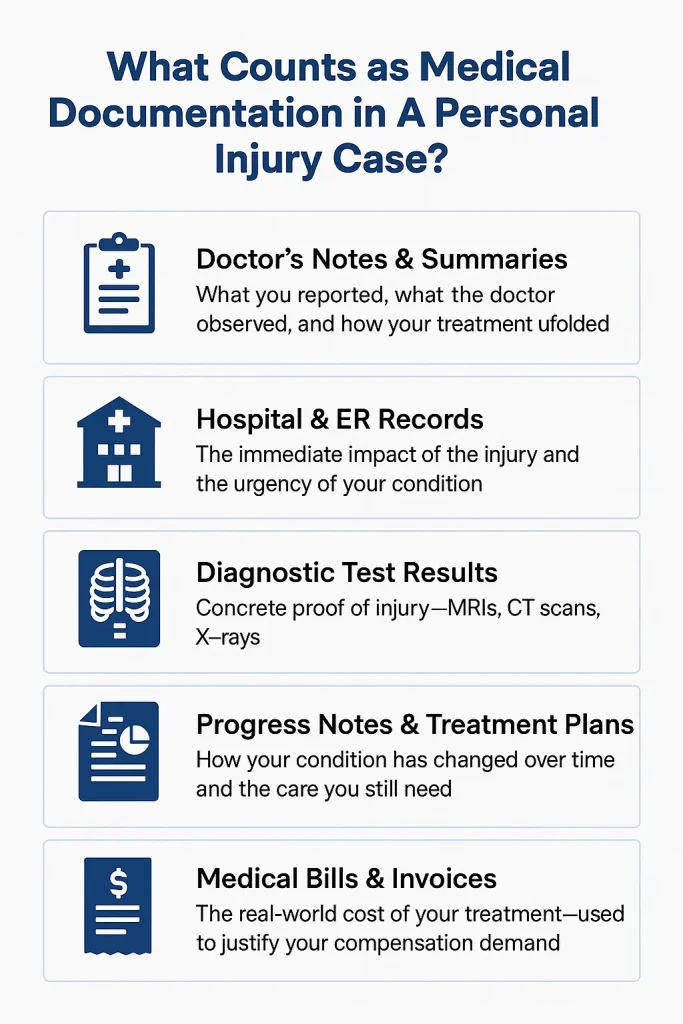
Forget just listing a diagnosis. Strong documentation tells the story of your injury and recovery. Here’s a closer look:
| Type of Document | What It Proves |
| Doctor’s Notes & Summaries | What you reported, what the doctor observed, and how your treatment unfolded |
| Hospital & ER Records | The immediate impact of the injury and the urgency of your condition |
| Diagnostic Test Results | Concrete proof of injury, MRIs, CT scans, X-rays |
| Progress Notes & Treatment Plans | How your condition has changed over time and the care you still need |
| Medical Bills & Invoices | The real-world cost of your treatment, used to justify your compensation demand |
Each of these pieces builds your case. When they’re detailed and consistent, they give insurers and defense attorneys less room to argue. When they’re missing or vague, even a valid claim can start to crumble.
Why Medical Records Matter So Much in a Personal Injury Case
You can be badly hurt, but if the paperwork doesn’t back it up, your claim can hit a wall.
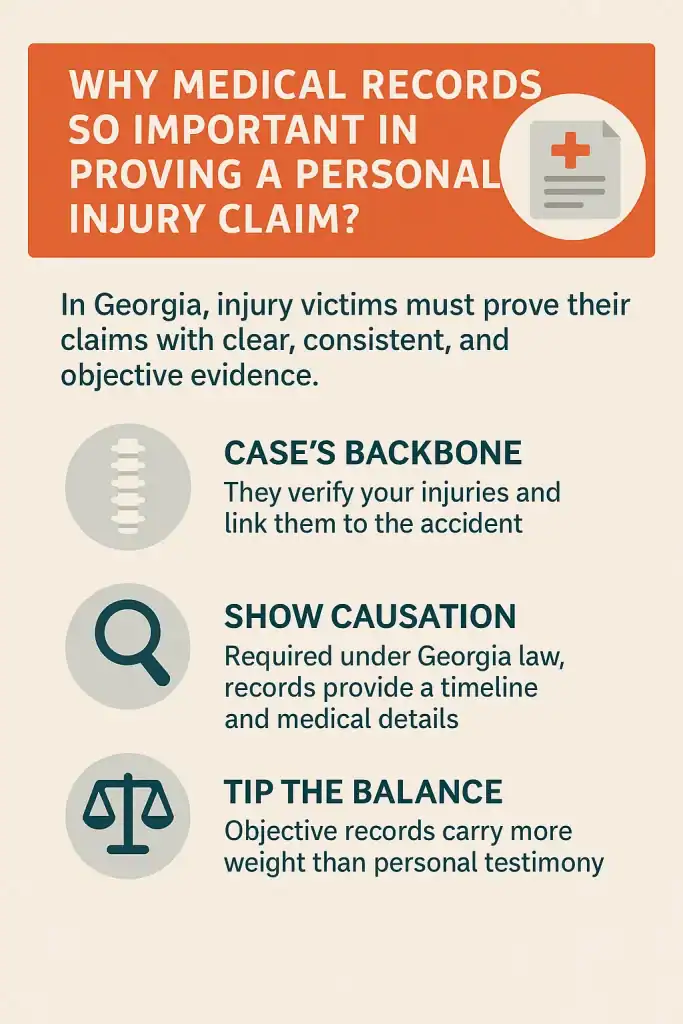
In Georgia, medical records are what tie your injury to the accident. They lay out the timeline: what happened, how bad it was, and what life has looked like since.
It’s not just about pain; it’s about proof. Imaging scans, specialist notes, and treatment updates help justify why you’re owed compensation.
Insurers and judges won’t go by what you say. They rely on clear, consistent records. The more complete your file, the less room there is for doubt.
What Insurance Companies Look for in Your Medical Documentation
Insurance adjusters don’t just glance through your medical records. They examine them closely. Here’s what they focus on:
Timelines: Did you get medical care right after the accident? Waiting too long can raise doubts.
Consistency: Do your symptoms match what your doctors have written in their notes?
Continuity of Care: Gaps in your treatment may suggest your injury wasn’t that serious.
Objective Proof: Scans like MRIs or X-rays and evaluations from specialists carry more weight than general complaints.
Compliance: Missing appointments or not following your treatment plan can work against you.
Missing documents, vague notes, or conflicting reports can delay or even reduce your settlement. For insurance companies, it’s not just what’s in your records. It’s also what’s missing that can weaken your case.
Mistakes That Can Undermine Your Medical Evidence
Medical records tell the story of your injury, but they only work if the story makes sense. That’s why certain mistakes, even unintentional ones, can quietly weaken your case.
Delaying care after an accident gives insurers an opening to say you weren’t really hurt. Skipped appointments create gaps that can’t easily be explained away.
Ignoring your doctor’s advice, whether it’s missing therapy or not taking medication, sends a similar message. Trying to handle things on your own at home might feel practical, but it leaves no real record behind.
And if what you say changes from one provider to another, insurers will take notice.
| Mistake | Why It Hurts Your Case |
| Gaps in Treatment | Suggests your injury wasn’t serious or you’ve recovered |
| Ignoring Doctor’s Advice | Shows noncompliance and casts doubt on the reliability of your recovery timeline |
| Self-Treatment | No diagnostic tests or professional oversight means your injury lacks legal |
| Inconsistent Reporting | Conflicting details from different providers weaken your credibility |
As one Georgia personal injury attorney says, “Your records are the backbone of your claim. Every visit, scan, and note fills in a piece of the puzzle, and what’s missing can matter just as much as what’s there.”
How to Build Strong Medical Evidence from Day One
The strongest personal injury claims don’t just rely on what happened, they rely on how well it was documented. From the moment you’re injured, every step you take can help or hurt your case.
Stick to the plan your doctors give you, and follow through on all referrals, tests, and therapy. Gaps or half-measures don’t just affect your recovery, but also give insurers an excuse to push back.
Also, keep a personal record. Track symptoms, appointments, and out-of-pocket costs. It’s not just helpful, but it shows consistency and reinforces what’s in the medical file. In personal injury cases, documentation isn’t just support, it is your case.
What to Do If Your Medical Records Are Incomplete or Inconsistent
Even the best doctors don’t always capture everything. A missed note, a rushed visit, or unclear wording can leave holes in your story. But in a personal injury case, those gaps matter.
Begin by requesting your records from every provider who treated you. Read them closely. If something important is missing or doesn’t sound right, raise it. Your attorney can ask for corrections or clarifying statements from the doctor.
For parts of your recovery that weren’t documented, like at-home care or symptoms between visits, keep a personal log. Small details can add real value when records fall short.
You don’t need perfect paperwork, but you do need a file that makes sense. The clearer your story, the harder it is to dispute.
How Insurers May Try to Undermine Your Medical Records
Insurance companies aren’t just checking that you were hurt. They’re looking for cracks or any sign your story doesn’t hold up under pressure. One overlooked detail, one delayed appointment, and they’ll use it to cast doubt on the whole claim.
This is how they try to do it:
| What are they on the lookout for | How they might use it in their favor or against your claim |
| Any Delays in Starting Treatment | “If it was serious, you would’ve gone in sooner.” |
| Any Gaps Between Appointments | “You must have been feeling a lot better.” |
| Missing Test Results | “No scans or labs? Then there’s nothing concrete to back this up.” |
| Contradictions in Notes | “Your doctor said one thing, you said another: something doesn’t add up.” |
| Subjective Complaints | “Pain is hard to measure, and we don’t see proof from a specialist.” |
Keep your care consistent, document everything, and assume every detail might be put under a microscope.
Conclusion: The Paper Trail That Protects You
When you’ve been injured, the story you tell matters, but it won’t stand on its own. What really makes it hold up is the medical documentation that shows exactly what happened, how it’s affected your life, and what it’s still costing you.
Small missteps like missing appointments or skipping tests can raise big questions. That’s why it pays to treat every doctor visit, scan, and therapy session as part of your case file, and not just your recovery.
If you’re unsure where your records stand or how to fix gaps, the team at Langrin Robertson Law can help. With experience handling complex injury claims across Georgia, they know how to turn medical facts into a solid case for compensation. When insurers look for holes, make sure what they find is a complete, well-documented story that backs you all the way.
FAQS
What is the average personal injury settlement in Georgia?
Most settlements in Georgia range from $15,000 to $75,000, depending on how serious the injury is and how strong the evidence looks. Severe cases with long-term impact can go much higher.
How do you prove causation in a personal injury case?
You’ll need a doctor to connect your injuries to the accident. Medical records, scans, and clear timelines are key. Without them, insurers may say it wasn’t caused by the crash.
How long do personal injury cases take to settle in Georgia?
Many wrap up in 6 to 18 months. If things are straightforward, it’s faster. If there’s a fight over who’s at fault or your treatment takes time, it may take longer.
What is the personal injury limit in Georgia?
There’s no set cap on damages in most Georgia cases. Your payout usually depends on the other side’s insurance and how much you were at fault, if at all.